Two years ago, in June 2010, we reported that Alcatraz Island was planning to go solar.We're happy to report now that the former prison is host to 1,300 solar panels, powering lights and appliances
that for 75 years were powered by diesel fuel
ferried across San Francisco Bay. Hurray for the National Park Service
(NPS) and the U.S. Department of Energy's (DOE) National Renewable
Energy Laboratory (NREL) to bring clean energy to national parks and
landmarks! The 307-kilowatt photovoltaic (PV) array sits on the roof of the main
Cellhouse building (shown in the photo), attached to two 2,000-amp-hour battery strings and
an inverter plant. The new 1,300-panel system produces close to 400,000
kilowatt-hours of electricity a year, reducing carbon dioxide (CO2)
emissions by about 337,000 kilograms a year and reducing the time the
diesel generator runs from 100% to 40%. The NPS also made energy
efficiency changes, such as better light bulbs and changes in operation
to reduce energy consumption. A massive solar battery system helps power the island when the sun
doesn't shine — and it, too, is hidden from the view of the 1.4 million
visitors the island and prison get each year. http://www.solaripedia.com/13/255/alcatraz_going_solar_with_1,360_panels.html
Showing posts with label california. Show all posts
Saturday, August 4, 2012
Sunday, February 28, 2010
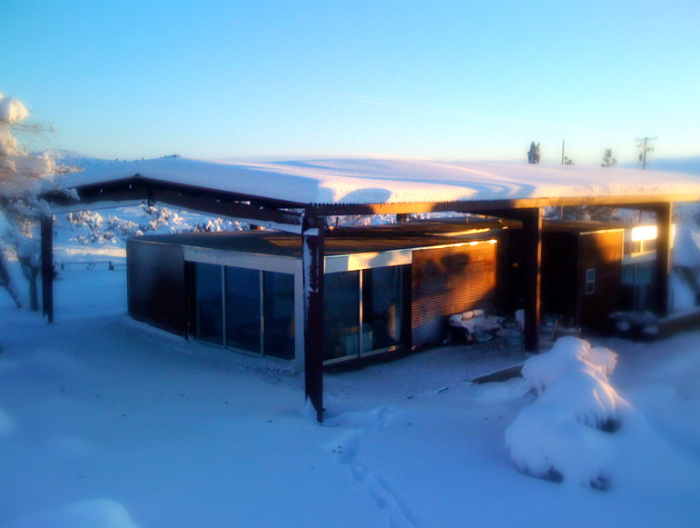
Rimrock Ranch Offers Shelter from the Storm
A home in the California desert sports a steel canopy that covers the entire home, offering tempering of the extremes -- days of 100-plus degree heat or flurries of snow. This thoroughly modern, light-filled house was a challenge for the architect to design a house that opened up to the desert yet functioned well in this variously hot and cold environment that can vary as much as 50 degrees in a one day. The roll-up door opens to a deep concrete porch that functions as a stage for bands who play at the ranch, and where audiences can pull up chairs or unfold rugs on the desert floor out front, lie back and hear the set unfold. Architect Lloyd Russell was inspired by a nearby adobe cabin that is kept cool by a shade structure above it, but he has applied a contemporary flair in this modern interpretation of an old idea. http://www.solaripedia.com/13/195/rimrock_ranch_captures_desert_breezes.html
Labels:
adobe,
california,
desert,
natural ventilation,
passive design
Sunday, January 31, 2010
Modular "Living Homes" Put Solar above the Deck
http://www.solaripedia.com/13/179/modular_steel_fabricated_into_living_homes.html“Zero Energy, Zero Water, Zero Waste, Zero Carbon, Zero Emissions” is the mantra of developer Steve Glenn of Living Homes. To that end he packed his house with energy-saving technology and sustainable and nontoxic materials. A solar-energy system on the roof is intended to provide 75 to 100 percent of the electricity and 80 to 90 percent of the hot water. There is a graywater system and a storm-water cistern for watering a garden of drought-resistant plants; the irrigation system will tap in to weather telemetry on the Internet to assess when to operate. A rooftop garden is designed to divert storm water and to help with insulation and absorb sunlight, thereby reducing the heat-island effect. Materials are carefully chosen for their healthful and sustainable properties.
Friday, January 29, 2010
Off-Grid and under a Sod Roof at Big Sur
http://www.solaripedia.com/13/178/cooper_point_shelters_off-grid_home_%28california,_usa%29.htmlThe Cooper Point house rises in a gentle ellipse of green, following the natural contours of the site near Big Sur, California. Designed by architect Mickey Muennig, it’s built like a bunker with massive concrete retaining walls at either end and all-glass walls in between. The roof is a continuation of the Big Sur environment, seeded with native grasses and wildflowers and six to eight inches of sod that makes it relatively fireproof, provides insulation and substantial savings in energy for this completely off-grid home.
Thursday, January 28, 2010
Earth-Sheltered Home Hovers over Pacific Ocean
http://www.solaripedia.com/13/178/Cooper+Point+Shelters+Off-Grid+Home+%28California%2C+USA%29.htmlThe owners of this home near Big Sur, California, estimate that they’ve cut their overall energy consumption by half, if not more. The house is completely self-sufficient and independent from the PG&E grid, with power coming from a bank of solar panels. The house’s long, tapered profile, reduces resistance to the winds that, on occasion, blow more than 100 miles per hour off the ocean. Architect Mickey Muennig of Big Sur, began his education by studying aeronautical engineering at Georgia Tech before switching to architecture.
Sunday, January 10, 2010
Umbrella House Reborn into Solar
Pugh+Scarpa Architects of Santa Monica adapted architect Paul Rudolph’s 1953 Umbrella House idea into a renovated California solar home. Rudolph's design used a trellis to shade the home from the hot Florida sun. P+S borrowed the idea of the trellis but installed solar panels into a steel-beam canopy that shades their new house, while providing electricity. The canopy is part of a 4.5-kilowatt solar system that powers almost the entire 1,900-square-foot house and the pool. There are 89 BP Solar amorphous photovoltaic solar panels mounted in the steel-beamed structures, on the roof, and atop the carport. “It’s not rocket science,” says project architect Angela Brooks. “Our system is simple. We used normal electricity. We did the wiring diagrams. It could all be done by a nonprofessional.”
Subscribe to:
Comments (Atom)