As food security becomes an issue everywhere, more and more people are opting for the ability to raise their own food year-round.
In the Appalachian Mountains, in Blacksburg, Virginia, the local YMCA
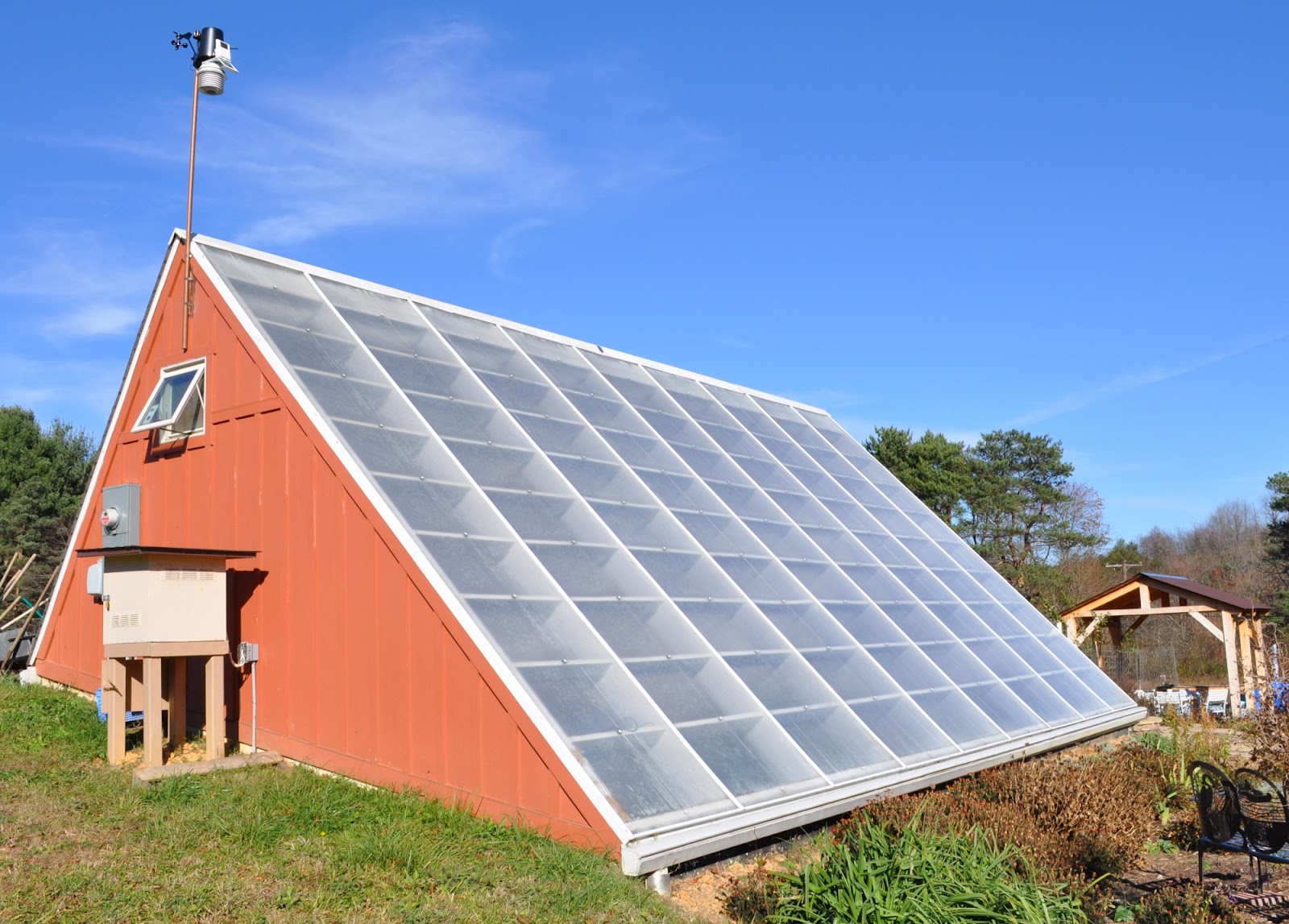
has built a solution for climates with cold winters.The YMCA Solar Greenhouse in Blacksburg, Virginia, USA, uses a novel way
to store energy collected from the sun: a subterranean heat sink of
soil, rocks and water beneath its interior planting beds. This system is
called the Subterranean Heating and Cooling System (SHCS), and it
collects solar energy and stores it for use when the sun is not shining.
This 18'x32' solar greenhouse is constructed with its long axis running
east and west, instead of north/south; it employs a heavily insulated
north roof as opposed to a transparent or translucent roof on the north side.
When outside conditions are very cold, heat is stored during the day in
the ground and walls of the greenhouse and released during the night to
keep the greenhouse air warm. Other solar greenhouses typically store
the sun’s energy in water barrels and/or rocks along the north wall
inside the greenhouse - taking up valuable floor space. Conventional
greenhouses are also constructed on a long north/south axis, with
glazing on both slopes of the roof; conventional greenhouses tend to
overheat when the sun is shining and get too cold during winter nights. This solar greenhouse was designed by retired physics professor, Dave Roper. At an estimated cost of $35,000USD in 2010, the greenhouse project could seem out
of reach to the average homeowner, but Roper says the design can be
adapted to smaller spaces and could be built using recycled materials, which could bring
costs down.
Showing posts with label USA. Show all posts
Tuesday, November 13, 2012
Saturday, August 4, 2012
Alcatraz Island Completes Photovoltaic System
Two years ago, in June 2010, we reported that Alcatraz Island was planning to go solar.We're happy to report now that the former prison is host to 1,300 solar panels, powering lights and appliances
that for 75 years were powered by diesel fuel
ferried across San Francisco Bay. Hurray for the National Park Service
(NPS) and the U.S. Department of Energy's (DOE) National Renewable
Energy Laboratory (NREL) to bring clean energy to national parks and
landmarks! The 307-kilowatt photovoltaic (PV) array sits on the roof of the main
Cellhouse building (shown in the photo), attached to two 2,000-amp-hour battery strings and
an inverter plant. The new 1,300-panel system produces close to 400,000
kilowatt-hours of electricity a year, reducing carbon dioxide (CO2)
emissions by about 337,000 kilograms a year and reducing the time the
diesel generator runs from 100% to 40%. The NPS also made energy
efficiency changes, such as better light bulbs and changes in operation
to reduce energy consumption. A massive solar battery system helps power the island when the sun
doesn't shine — and it, too, is hidden from the view of the 1.4 million
visitors the island and prison get each year. http://www.solaripedia.com/13/255/alcatraz_going_solar_with_1,360_panels.html
Labels:
active solar,
alcatraz,
california,
photovoltaics,
PVs,
USA
Wednesday, December 16, 2009
Open PV Database Tracks US Solar Installations
The Open PV Project is a community-driven database, fostered by the National Renewable Energy Laboratory, of photovoltaic (PV) installations around the US. It collects, organizes and distributes info on location, size, cost and date of every PV installation in the USA. A very cool animation is superimposed on a US map showing all logged PV systems installed since 1998.
Subscribe to:
Posts (Atom)