Saturday, January 16, 2010

Got Portable Solar?? Help Haiti Now


One of the organizations best placed to make an immediate difference is Partners in Health. They have operated medical facilities in Haiti for more than two decades and have numerous people on the ground. Immediate needs include:

# Help us track down helicopters! That's our #1 need right now is transport. There are thousands of badly injured ppl in Port-au-Prince, and there are PIH hospitals, supplies and teams standing ready to treat them in the central plateau. It's a long, difficult drive over uncertain roads -- OR a 10-min helo ride.

# Satellite phones! Cell communications are mostly down and we can't send docs out into PAP with no way to be in touch

# Donate medicine, food, blankets, supplies ... anyone with in-kind products to donate can write to procurement@pih.org

# Lend your time and skills -- we need experienced trauma surgeons, pediatric trauma surgeons, burn specialists, nurse anesthetists, trauma nurses

# We need solar chargers, generators, fuel for generators

# Water purification that does not require electricity -- so massive quantities of water purification tablets or a system that is standalone such as solar-powered

# Transport -- we have had a few offers of private planes plus a big Air Canada jet -- we are filling them with doctors and supplies and mobilizing

Friday, January 15, 2010

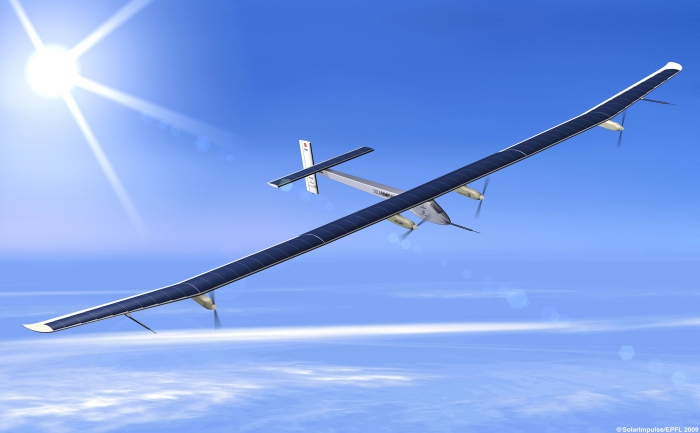
Solar Power Used to Fly Airplane


Solar Impulse is an airplane powered by the sun. It provides a window for the technologies of the future, but already under development are solar cells offering a better efficiency-weight ratio, intelligent systems of energy management, materials as lightweight as they are resistant and a storage system to rival the most efficient. On earth at midday, each m2 of land surface receives the equivalent of 1000 Watts, or 1.3 horsepower of light power. Over 24 hours, this averages out to 250W/m2. With 200m2 of photovoltaic cells and a 12 percent total efficiency of the propulsion chain, the Solar Impulse airplane’s motors achieve no more than 8 HP or 6kW – roughly the amount of power the Wright brothers had a available to them in 1903 when they made their first powered flight. And it is with that small amount of energy, optimized from the solar panels to the propeller, that Solar Impulse is striving to fly day and night without fuel! Someday, the solutions developed for the solar airplane could find other applications in the building industry where efficiency and reliability are determining factors.

Wednesday, January 13, 2010

Learning with Sun and Nature at IslandWood


IslandWood, an outdoor learning center near Seattle, Washington, targets students from schools on free and reduced lunch programs for its School Overnight Program where they are immersed in experiences with nature and sustainability. The site and the buildings are designed to be sustainable, featuring solar meadows and building orientations that maximize passive solar gain. High performance windows optimize solar heat gain and reduce energy consumption. Natural ventilation replaces air conditioning, with operable window openings and skylights for maximum air circulation. Rainwater is collected from the roofs of several buildings and used for landscape irrigation. A Living Machine treats wastewater by using plants to filter impurities. Photovoltaics provide power and water is heated by the sun. Even trees that were cleared to make way for buildings and solar access have been cut, dried and milled and then used for exterior siding and interior trim throughout project.

Monday, January 11, 2010

Building Mimics Processes of a Tree


Made up of biological and technical 'nutrients' the Bernheim Arboretum Visitor Center building exemplifies the Cradle-to-Cradle approach to design, according to William McDonough, author of Cradle To Cradle and architect of the project. "Imagine a building like a tree; it makes oxygen, sequesters carbon, fixes nitrogen, purifies water, builds soil, provides habitat for hundreds of species, accrues solar energy as fuel, makes complex sugars and food, creates micro climates and changes colors with the seasons. The Bernheim Visitor Center can do all this and more. If a building could be alive it would be this building."

Sunday, January 10, 2010

Umbrella House Reborn into Solar


Pugh+Scarpa Architects of Santa Monica adapted architect Paul Rudolph’s 1953 Umbrella House idea into a renovated California solar home. Rudolph's design used a trellis to shade the home from the hot Florida sun. P+S borrowed the idea of the trellis but installed solar panels into a steel-beam canopy that shades their new house, while providing electricity. The canopy is part of a 4.5-kilowatt solar system that powers almost the entire 1,900-square-foot house and the pool. There are 89 BP Solar amorphous photovoltaic solar panels mounted in the steel-beamed structures, on the roof, and atop the carport. “It’s not rocket science,” says project architect Angela Brooks. “Our system is simple. We used normal electricity. We did the wiring diagrams. It could all be done by a nonprofessional.”