Two years ago, in June 2010, we reported that Alcatraz Island was planning to go solar.We're happy to report now that the former prison is host to 1,300 solar panels, powering lights and appliances
that for 75 years were powered by diesel fuel
ferried across San Francisco Bay. Hurray for the National Park Service
(NPS) and the U.S. Department of Energy's (DOE) National Renewable
Energy Laboratory (NREL) to bring clean energy to national parks and
landmarks! The 307-kilowatt photovoltaic (PV) array sits on the roof of the main
Cellhouse building (shown in the photo), attached to two 2,000-amp-hour battery strings and
an inverter plant. The new 1,300-panel system produces close to 400,000
kilowatt-hours of electricity a year, reducing carbon dioxide (CO2)
emissions by about 337,000 kilograms a year and reducing the time the
diesel generator runs from 100% to 40%. The NPS also made energy
efficiency changes, such as better light bulbs and changes in operation
to reduce energy consumption. A massive solar battery system helps power the island when the sun
doesn't shine — and it, too, is hidden from the view of the 1.4 million
visitors the island and prison get each year. http://www.solaripedia.com/13/255/alcatraz_going_solar_with_1,360_panels.html
Saturday, August 4, 2012
Sunday, July 29, 2012
Can We Learn from Animal Constructions?
http://www.solaripedia.com/13/377/5225/bower_bird_love_nest.html
Do other animals have anything to teach humans about sustainable design and building?
The Finnish architect Juhani Pallasmaa points out that animals have developed many inventions familiar to us from our own
construction such as roadways (ants), covered streets (termites), deep wells
(termites), heating and moisture regulation systems (termites, bees, ants and
others), stairways and ramps (termites), and hinged doors with handles
(trap-door spiders). He says that human behavior and construction are dangerously detached from their
ecological context, partly because we also seek to represent our world symbolically in our
construction. Human architecture is always more dictated by cultural, metaphysical
and aesthetic aims than by pure functionality and reason, he adds. Other animals, however, fulfill
strict criteria for economy and efficiency through minimizing the use of
material and labor - sustainable building by necessity for survival and procreation of the species. So how do we combine our technological advances with ecological requirements? Perhaps a look at a few animal constructions can reveal some important answers.
Tuesday, July 24, 2012
Recreation Center in Germany Powers with Solar
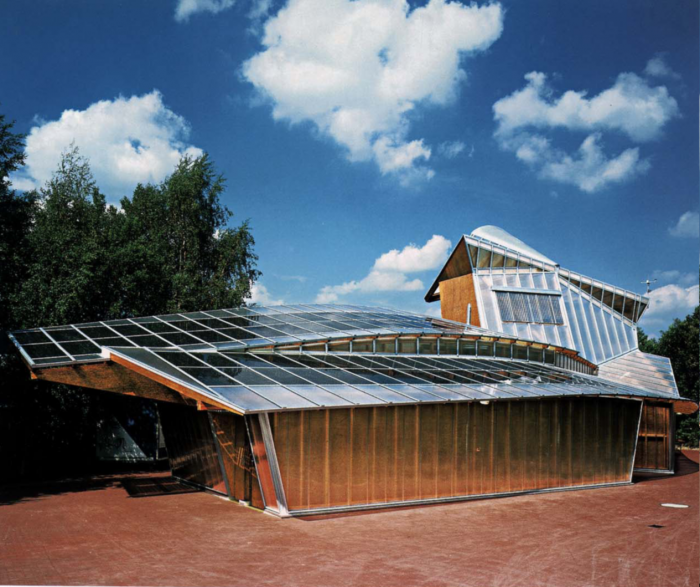
On Germany's Bath Island, the Steinhude Sea Recreation Facility supplies all of its power needs. Energy self-sufficiency is achieved with photovoltaic panels, solar hot
water collectors, a seed-oil-fueled cogeneration microturbine,
daylighting, natural ventilation, passive solar design, building
automation, and high-performance materials. These systems provide
complete lighting and power needs for the building, as well as enough
energy to recharge a fleet of eight photovoltaic-powered rental boats,
with excess electricity to sell back to the utility grid. This recreation center also employs graywater reuse and rainwater harvest systems that supply public and staff toilets. http://www.solaripedia.com/13/319/Steinhude+Rents+Solar-Powered+Boats.html
Labels:
germany,
passive solar,
photovoltaics,
PVs,
rec center
LEED versus Passive House Standards Commentary
Check out the commentary by Jacob Gordon. He reviews LEED versus Passive House standards on The Good 100 blog. Titled "Follow or Get out of the Way: The household name in green construction needs to innovate in order to keep up with the competition." Imagine if teachers gave out grades on the first day of school based on students’ promises of how hard they each plan to study. Oddly, we use this backward system to grade green buildings in the United States.
Labels:
LEED,
passive design,
passive house,
passive solar,
passivhaus,
solar
Friday, July 20, 2012
Is climate change, and a new demographics, creating a "metro moment," or leading to 'It's a a sprawl world, after all"?
by Francesca Lyman, Special to Sacramento Bee - Is our culture inextricably bound up
with the boundless American dream of suburbia? Judging from the glossy real
estate brochures still selling spacious villas and oversize homes, it seems as
though success, for many, remains the fantasy of driving down a wide,
palm-tree-lined boulevard among the big lawns and mansions of Beverly Hills,
just like the character in Woody Allen's famous scene in "Annie Hall."
This latest burst of the housing bubble, however, has exposed the dark
underside of the suburban dream – with its cascading foreclosures, shuttered
malls and shopping centers – on an enormous scale.
Many experts believe that coming concerns over climate change, and new demographic and economic trends, will cause a booming demand for infill housing. Others fear there isn't enough supply to deliver on this demand, because infill in cities is so much more expensive. The result could be that we're likely to see the opposite happening -- a migration to sprawling greenfields again.
That creates opportunities for designers and city planners to produce shining examples that make "walkable" work, since real estate watchers do agree on a demand for suburbs to remake their cores in the form of traditional cities and downtowns, says David Mogavero, a Sacramento architect specializing in infill projects. Plus, if the patterns of past development were continued at the same rate, the impact on traffic, air quality and farmland "would be devastating," say urban planners like the Sacramento Area Council of Government's Mike McKeever.
Read more here: http://www.sacbee.com/2012/06/24/4583230/the-conversation-our-new-lots.html#storylink=cpy
Francesca Lyman, special to The
Sacramento Bee, California Forum section
Source: 06/24/2012
Friday, September 23, 2011
Should Another Owl Be Killed So This One Can Live?
Once the West's poster child for endangered species, the Northern Spotted Owl is now threatened by one of its own kind --- a striped cousin called The Barred Owl. The feathers are flying --- among biologists, conservationists and animal ethicists.
The effort to save the northern spotted owl during the last 20 years has helped preserve old-growth forests, even if it sparked the 'timber wars,' battles between conservationists, timber companies and the construction industry. But now the owl faces a new threat: a closely-related cousin, the barred owl. This larger, brasher, faster-breeding transplant from the East Coast has invaded the spotted owl's territory, which ranges from Northern California to Washington State.
The U.S. Fish and Wildlife Service is proposing an experiment to selectively take out barred owls, by lethal and nonlethal means, to determine if this would give the spotted owl any advantage. But that's sticking in the craw of some conservationists, birding groups and animal-rights advocates because the experiment alone could mean killing hundreds, if not thousands, of these birds.
The barred owl removal plan poses an ethical question to the public: Does it make sense to kill some species to save others? At what point should we intervene? Or should we step in at all? "Such questions often go unarticulated, even though public agencies confront these hard choices all the time," says William Lynn, a bioethicist at Clark University in Worcester, Mass., who was brought in by the Fish and Wildlife Service to convene discussions with stakeholders on the ethical issues. Even before wildlife officials release their draft environmental impact statement this fall, the controversy is generating hot debate among conservationists, wildlife biologists and animal rights activists.
Francesca Lyman reports for The Sacramento Bee California Forum section September 18th, 2011.
IMAGE: John and Karen Hollingsworth, US Fish and Wildlife Service
Monday, May 2, 2011
Desert Living Center Educates in Las Vegas
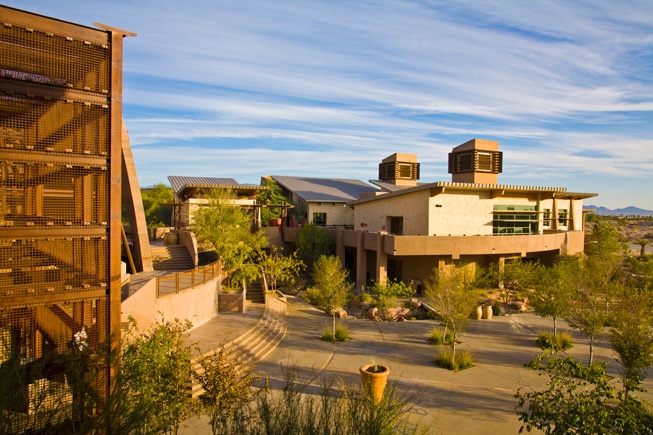
The Desert Living Center (DLC) in Las Vegas, Nevada, USA, is showcases green building methods, materials and technologies that are appropriate for a desert climate, such as thick straw bale and rammed earth walls, and evaporative cooling towers that lower heating and cooling energy use. The buildings are also orientated to maximize solar for heat and light using passive design principles, with minimal mechanical systems. Stormwater is collected in this area of very low rainfall so that it can be used to irrigate gardens. Walls are insulated with shredded blue jean material, and salvaged materials include recycled railroad trusses that form a roof structure. Solar panels cover parking areas and are used as design elements in free-standing pole-mounted systems. The five DLC buildings are part of the Las Vegas Springs Preserve, a 180-acre park that features a 1.8 mile trail system with interpretive overlooks, historic structures and archaeological sites; an eight-acre botanical garden with thousands of native and drought-tolerant plants, outdoor classrooms and a cooking demonstration area, and an accessible garden; the Cienega desert wetland that serves as a home for hundreds of native plant, bird and animal species; and a reconstructed cauldron pool depicts the natural springs that once bubbled from beneath the valley floor.
Labels:
arid,
desert,
dlc,
enivornmental education,
green architecture,
green building,
las vegas
Subscribe to:
Posts (Atom)