Saturday, February 20, 2010
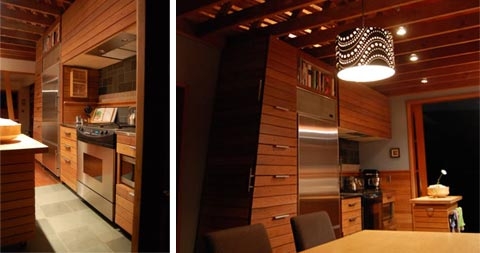
Recycled Home in Portland
An architect in Oregon takes eight years to realize a passive home built of mostly scrap and waste products, where his designs were not preconceived but rather inspired through available materials. His Portland bungalow yielded studs that were originally cut around 1925, and once de-nailed, ripped, and planed, they revealed beautiful material, he says. The home won the "Greenest Home in America" in 2008.
http://www.solaripedia.com/13/191/oregon_bungalow_is_recycled_and_passive.html
Thursday, February 18, 2010
Organic Design Blooms at Sea Ranch Chapel
After more than twenty years the Sea Ranch Chapel, on the coast of California north of San Francisco, continues to draw visitors from around the world. Designed by architectural sculptor James Hubbell and built by master craftsman Tombe Kumaran, it is a gem of organic architecture that would perhaps have defied computer-aided-design.http://www.solaripedia.com/13/193/Sea+Ranch+Chapel+Organic+Form+%28USA%29.html
Sunday, February 14, 2010
Aqua Tower Ripples in Chicago
Aqua Tower in downtown Chicago uses a rectilinear plan in its reinforced concrete structure, with hotel, rental apartments and condominiums, as well as penthouses on the top two floors. The architect figured out the envelope's curvilinear architectonic forms while working with the building’s rectangular footprint. At the same time, she devised ways it could be energy efficient through sustainable strategies, using passive solar principles. http://www.solaripedia.com/13/188/rippling_tower_undulates_in_chicago.html
Friday, February 12, 2010
Latvian Eco-Development: No Fences Make Good Neighbors
http://www.solaripedia.com/13/186/eco-development_is_all-natural_%28latvia%29.html
Near each of the 300 unique homes in Sun City, Latvia, is a small lake and forest. Central sewer is laid under the roots of pine and fir trees, along with high-speed Internet, and electricity. The homes use geothermal heat pumps that convert the warmth of the earth into heat for the houses. All-natural materials are used such as wood, stone, log, brick and cane. No fences are allowed so that abundant wildlife can roam freely across the landscape.
Labels:
eco-community,
eco-development,
latvia,
neighborhood
Sunday, February 7, 2010
Camping Supplies Are Solar Powered
Solar camping equipment complements the impact-free camping experience.When I was backpacking a couple of years ago in Colorado's Raggeds Wilderness area, friends brought a solar shower. They left it sitting on a rock while everyone was out exploring, and by the time of return, the water had heated to a toasty 125 degrees. The sun can also power lanterns and cell phones via backpacks and some new concept tents.http://www.solaripedia.com/13/182/camping_with_solar_friendly_devices.html
Tuesday, February 2, 2010
Largest US Solar Farm Soaks up Sun in Florida
And produces 25 megawatts of electricity! This $150 million plant came in $22.5 million under budget and took just 10 months to build - several months ahead of schedule. Its 92,000 solar panels can withstand 130-mph winds. The Desoto Solar Farm is built to last at least 30 years, and it will take from 25 to 30 years for Florida Power & Light, the owner, to recoup its investment. Construction of this facility also created 400 jobs! http://www.solaripedia.com/13/180/florida_sun_powers_largest_us_solar_farm.html
Sunday, January 31, 2010
Modular "Living Homes" Put Solar above the Deck
http://www.solaripedia.com/13/179/modular_steel_fabricated_into_living_homes.html“Zero Energy, Zero Water, Zero Waste, Zero Carbon, Zero Emissions” is the mantra of developer Steve Glenn of Living Homes. To that end he packed his house with energy-saving technology and sustainable and nontoxic materials. A solar-energy system on the roof is intended to provide 75 to 100 percent of the electricity and 80 to 90 percent of the hot water. There is a graywater system and a storm-water cistern for watering a garden of drought-resistant plants; the irrigation system will tap in to weather telemetry on the Internet to assess when to operate. A rooftop garden is designed to divert storm water and to help with insulation and absorb sunlight, thereby reducing the heat-island effect. Materials are carefully chosen for their healthful and sustainable properties.
Subscribe to:
Posts (Atom)


