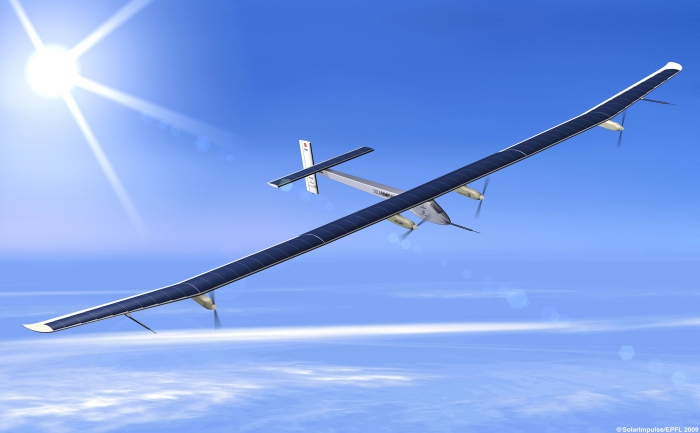
I am more than excited about the longest and highest solar-powered airplane flight that was just completed in Switzerland. This is one of those events for which I feel privileged to be alive! Back in January, we featured the Solar Impulse experimental solar-powered aircraft on Solaripedia. On Wednesday, 7 June, 2010 the Impulse was launched, and 26 hours later on the next day it landed safely in Switzerland after successfully flying through the night. The historic feat is a step toward the makers' aim of circling the globe using the power of the sun to fuel the plane. The aircraft uses super-efficient solar cells and batteries to stay in the air after the sun's rays are on the other side of the earth. If you're not ecstatic about it yet, please read more about it - the implications are staggering!
Showing posts with label solar airplane. Show all posts
Friday, July 9, 2010
Friday, January 15, 2010
Solar Power Used to Fly Airplane
Solar Impulse is an airplane powered by the sun. It provides a window for the technologies of the future, but already under development are solar cells offering a better efficiency-weight ratio, intelligent systems of energy management, materials as lightweight as they are resistant and a storage system to rival the most efficient. On earth at midday, each m2 of land surface receives the equivalent of 1000 Watts, or 1.3 horsepower of light power. Over 24 hours, this averages out to 250W/m2. With 200m2 of photovoltaic cells and a 12 percent total efficiency of the propulsion chain, the Solar Impulse airplane’s motors achieve no more than 8 HP or 6kW – roughly the amount of power the Wright brothers had a available to them in 1903 when they made their first powered flight. And it is with that small amount of energy, optimized from the solar panels to the propeller, that Solar Impulse is striving to fly day and night without fuel! Someday, the solutions developed for the solar airplane could find other applications in the building industry where efficiency and reliability are determining factors.
Subscribe to:
Comments (Atom)