Dale Peterson has an extraordinary ability to envision new life for old things. His workshop is crammed full of everything from doorknobs and old miner's lamps to oil cans. It is a junkyard paradise on a micro scale. All these things were functional at one time in the past. Dale's goal is to give them new life, to bring their style and class to a different purpose. Read the article in Yakima Magazine.
Monday, August 7, 2017
Friday, March 31, 2017
Raisin' in the Sun: Wine Grapes and Solar Power
Vigneron Gary Cox set a long-term goal of environmental sustainability for his Cox Canyon Vineyards and Ellensburg Canyon Winery in 1999, becoming the first sustainable vineyard and winery in Kittitas County, Washington USA. Recently, Cox invested in renewable energy by installing solar panels on his property to provide energy for processing his cabernet franc, riesling and malbec wine grapes. Cox's solar array comprises 85 solar panels on a portion of his 17-acre vineyard that wouldn't accommodate vines anyway. Read to full article here: Yakima Magazine Article MARCH 2017
Labels:
active solar,
photovoltaics,
PVs,
solar winery,
washington state
Monday, September 26, 2016
The Best Solar Panels 2016
Reviews.com set out to find the best solar panels.
Investing in solar energy is an excellent solution, but between hardware, installation, and the electronic components, the up-front price tag is enough of a deterrent for many. Factor in the notion that you may feel uncertain when it comes to choosing the most powerful and efficient product, and going solar doesn’t feel like a viable option. That’s why the team at Reviews.com took to researching 188 of the top solar panel manufacturers on the market to determine which ones are worth the investment.
How Reviews.com Found the Best Panels:
To see Reviews.com's top picks for the best solar panel manufacturers, as well as tips for finding a great installer, read their full review: http://www.reviews.com/solar-panels/
Investing in solar energy is an excellent solution, but between hardware, installation, and the electronic components, the up-front price tag is enough of a deterrent for many. Factor in the notion that you may feel uncertain when it comes to choosing the most powerful and efficient product, and going solar doesn’t feel like a viable option. That’s why the team at Reviews.com took to researching 188 of the top solar panel manufacturers on the market to determine which ones are worth the investment.
How Reviews.com Found the Best Panels:
- They cut any company that hasn’t been around long enough to establish a good reputation — and with most warranties lasting between 10 and 25 years, they omitted any company that hasn’t been around for at least 10 years
- They required at least 230 watts of power, to allow for fewer panel purchases with more efficiency
- They looked for the right efficiency ratio by calculating energy output from a panel compared to the input from the sun
- They evaluated customer service, website user-friendliness, and service warranties
To see Reviews.com's top picks for the best solar panel manufacturers, as well as tips for finding a great installer, read their full review: http://www.reviews.com/solar-panels/
Thursday, August 25, 2016
DAR Historic Building in Washington, D.C. Uses Solar Power
The Daughters of the American Revolution (DAR) Constitution Hall photovoltaic system helps the DAR to stabilize and reduce electric energy costs for its complex of historic buildings in Washington, D. C., just a few hundred yards from the White House. The rooftop 59kW solar panel array installation was completed in June 2014 and produces about 100,786 kWh of energy per year to help offset the energy demand of DAR Headquarters. Designed to house the annual DAR convention, Constitution Hall (as of August 2015) was designated a National Historic Landmark Building in 1985 and is Washington D.C.’s largest Concert Hall, with more than half a million patrons each year. DAR has had a conservation committee dedicated to environmental issues for more than 105 years.
DAR Historic Hall Uses Solar Power
Solar Energy Dwarfs All Other Energy Sources
Solar energy potential DWARFS the potential from every other energy resource on the planet. The chart below was produced in 2009 by Perez & Perez and provides the estimates of finite and renewable planetary energy reserves in Terawatt-years -- showing that the energy potential for renewables is ANNUAL energy potential, whereas the energy potential from non-renewables is for TOTAL known reserves. Go sun!
Solaripedia Online Green Architecture Resources
2016 Summer Olympics Stadium in Rio Sports Solar Power
Maracana Stadium in Rio, site of the 2016 Summer Olympics, is ringed by more than 1,552 rooftop solar panels from China. Since the 2014 World Cup, the 390 kW solar power system has been providing free, unlimited clean energy to the stadium, reducing 2,560 tons of carbon dioxide emissions each year. Brazil uses mostly hydropower but the country has one of the highest solar incidences in the world – every square meter exposed to the sun in Rio receives enough energy to run the average Brazilian shower for more than an hour per day. Sustainability Plan for 2016 Olympics:https://www.rio2016.com/sustentabilidade/en/
Labels:
brazil,
photovoltaics,
PVs,
stadium,
summer olympics 2016
Wednesday, May 18, 2016
An Ecological Resort in Costa Rica Celebrates Sustainability
Finca Rosa Blanca is an ecological coffee plantation resort in Costa Rica where the proprietors use the power of the sun, natural wastewater treatment, sustainable materials, local food, native plantings, and organic coffee growing methods to wed natural beauty and luxury with long-term sustainability.
The resort sits almost 4,000 feet above sea level, on nine acres overlooking the capital city of San Jose in the valley far below. Finca Rosa Blanca rests in the shadow of Barva Volcano - directly above the resort - the largest in land mass of the many volcanoes in Costa Rica. Visitors also discover wild rivers and cascading waterfalls, big cats, quetzals, tapirs and eagles. Roughly a quarter of Costa Rica's area is made up of National Parks. Finca Rosa Blanca also offers lessons in creating a “green” bedroom in your own home, as well as lessons in sustainability on a broader level.
Solar-Powered Greenhouse Fosters New Growth in Old Pittsburgh Neighborhood
In the economically distressed Homewood
neighborhood of Pittsburgh sits a greenhouse that is mere feet from city
utilities infrastructure, but there are no city utility connections in this
building. Powered exclusively by energy from the sun through a revolutionary DC
micro grid, the Homewood greenhouse requires no supplementary heat, energy, or
water. Inside the greenhouse, Oasis Farms and Fishery is perfecting the revolutionary agricultural
technology called aquaponics, where plants are combined with aquatic life
to create a sustainable, diverse system of food growth and cultivation. It is a
revolutionary urban farming initiative that provides a model for agricultural,
economic, and sustainable development for even the most remote and
under-privileged locations. Designed to increase food productivity and density,
especially in urban areas, this experimental greenhouse not only grows food,
but acts as a global model for developing nations.
The greenhouse includes:
- Aquaponics systems to grow plants and fish
- A STEM (Science, Technology, Engineering, Math)
education classroom under a solar canopy
- A rainwater collection and purification system, with
both 1,200 and 500-gallon cisterns, that uses a series of ultraviolet
light, filters, and pumps to make the water safe for the aquatic living
environment
- Maintenance-free materials and design
- Zero operating cost
Labels:
photovoltaics,
Pittsburgh,
PVs,
solar greenhouse
Saturday, November 21, 2015
Smart Phone Apps for Solar and Green Building
http://www.solaripedia.com/70/resources.html#Apps
Using solar energy is a lot easier these days thanks to several great iPhone apps. Pictured is the screen for Easy Solar that offers design and measurement tools for professionals. On the other hand, Solar Panel Advisor app is fun for anyone who wants to see their phone behave as a solar panel. And the Pyranometer app allows you to measure the solar irradiance in watts per square meter for and education. Enjoy!
Dirty Laundry Exposed at Thrift Store Chain
http://invw.org/2015/10/28/the-thrift-store-chain-that-dressed-up-like-a-charity-and-got-sued/
Recycling clothing and small household items is a positive thing for the environment, right? So why is the Savers corporation and its Value Village thrift stores under fire? The $1.2 billion per year giant appears to be masquerading as a big do-gooder for non-profits with its slogan: "Good Deeds. Great Deals." In reality, a small fraction of between 8 and 17 percent of revenue goes to charities. Already in hot water in Minnesota, the Washington State for-profit thrift business is finally being scrutinized in Washington - as its board chairman, Tom Ellison, resides luxuriously in his waterfront mansion. Read the full investigation by Francesca Lyman and Investigate West.
Friday, November 20, 2015
Modular, Ultra-Green, Solar Classroom Inspires Sustainability
Unveiled in 2015, this could be the classroom of the future. Located at the Phipps Conservatory in Pittsburgh, this is one of the first completely sustainable, modular classrooms in the U.S. Fabricated by EcoCraft Homes and developed by the SEED Collaborative, the SEED Classroom features non-toxic materials, generates its own energy, and recycles water on-site. A hands-on sustainable learning space built to Living Building Challenge standards, it impacts thousands of children with its net-zero energy, net-zero water, sustainable materials, daylighting, urban agriculture and equity components.
http://www.solaripedia.com/13/422/SEED+Classroom+Inspires+%28Pittsburgh%2C+USA%29.html
TAGS: green architecture, green building, modular construction, passive house, solar, energy efficient, pittsburgh
http://www.solaripedia.com/13/422/SEED+Classroom+Inspires+%28Pittsburgh%2C+USA%29.html
TAGS: green architecture, green building, modular construction, passive house, solar, energy efficient, pittsburgh
Labels:
modular classroom,
photovoltaics,
Pittsburgh,
PVs
Sunday, October 12, 2014
Usonian Homes on Display at Polymath Park in Pennsylvania

Polymath Park was designed by a Frank Lloyd Wright apprentice to be a small community of “Usonian” homes, Frank Lloyd Wright's concept for housing for the common people. Located in Western Pennsylvania, the 125-acre (0.51 km2) property now hosts three homes, connected by unpaved roads on a mostly wooded site. Peter Berndtson, one of the original Wright apprentices at Taliesin, created a 1962 master plan for Polymath Park that allowed for 24 dwellings to be sited in individual, circular clearings in the forest. Ultimately, only two of his home designs were built on the property and are still standing. In 2007, one of Wright’s Usonian homes was deconstructed in Illinois, relocated to the Polymath site, and then faithfully reconstructed according to Wright’s original design. Berndtson's homes are known as the Balter House (1964) and the Blum House (1965), both of which were used as summer homes for the Blum and Balter families. The good news is that you can tour these homes or stay for the night!
Polymath Park Resort
Thursday, October 2, 2014
The Well-Behaved Building - Oct 8-10 NYC
Submitted by Francesca Lyman
If you're working on reducing energy and resource use and enhancing sustainability, well-being and community in buildings, the Garrison Institute has an invitation for you. October 8 - 10 please join your fellow building owners, managers, researchers and community organizers for our annual Climate, Buildings and Behavior symposium, which deals with the human dimensions of improving building performance, including energy use behavior.
This year's meeting, “The Well-Behaved Building: Developing Community, Well-Being and Resilience in Buildings,”
explores behavioral and holistic approaches that help make buildings
into thriving communities while improving efficiency. Presenters include
leading building experts like Barbara Ciesla, Gina Ciganik, Rachel Gutter, John McIlwaine, Jonathan Rose and others, as well as thought leaders from relevant fields like sociologist Jenni Cross, teacher Steve Ritz, activist Alexie Torres-Fleming, resilience expert Andrew Zolli and meditation teacher Sharon Salzberg.
The
symposium is held at the Garrison Institute, a beautiful, renovated
monastery on the Hudson River an hour north of Manhattan on the
MetroNorth train line. Scholarships are available for non-profit
professionals. You can learn more and register here, or call the Institute at 845-424--4800.
Tuesday, April 2, 2013
This just in!
by Francesca Lyman
Well, don’t stop the presses:
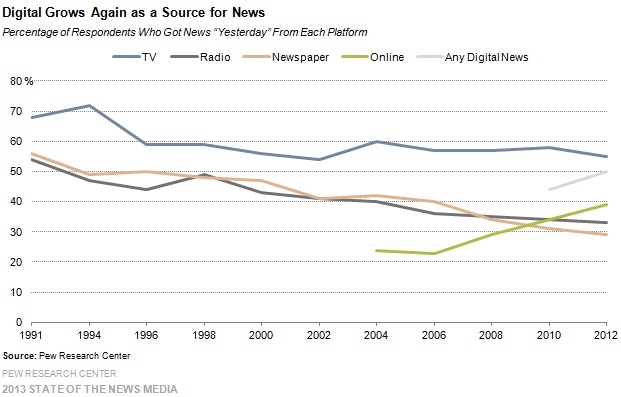
Annual Pew media survey reports woes for traditional media, a continuing rise
in digital journalism; and a report on Entertainment news squeezing out Environmental
coverage
What’s black and white, and read all over? Not newspapers, as the old children’s riddle once told
us, nor traditional news media, according to the Pew Research Center’s annual
report, “State of the News Media,”
out March 18th.
Analyzing
the media industry’s economics, audience and viewership, and prospects by
sector, the report details continuing rifts in the news media landscape, cuts
particularly affecting newspapers, and an ongoing rise in digital media.
This
may not be news to readers of Solaripedia,
but most news consumers are unaware of these profound changes. Surprisingly,
some 60 percent of Americans say they’re unaware of these trends, while 31
percent have stopped turning to news outlets they used to depend on.
Since
last year, the newspaper industry has lost the most ground to rivals in the
technology industry. The Center’s
estimates for newsroom cutbacks in 2012 “put industry employment down 30% since
its peak in 2000 and below 40,000 employees for the first time since 1978.” On cable TV, coverage of live events
during the day, “which often requires a crew and correspondent, fell 30% from
2007 to 2012,” with interview segments up 31%.
In 2011, the center found,
losses in print advertising dollars “outpaced gains in digital revenue by a
factor of roughly 10 to 1, a ratio even worse than in 2010.” Their conclusion,
when circulation and advertising revenue are combined, is that “the newspaper
industry has shrunk 43% since 2000.” The result is a news industry understaffed
and less prepared than ever to uncover stories or dig deep into emerging
trends.
Nevertheless they found that
news is becoming a more important and pervasive part of people’s daily lives. “That, in the end,” they wrote, “could
prove a saving factor for
the future of journalism.”
The brightest spot perhaps is
that online news consumption rose sharply during the last two years, as digital
platforms have spread. Online news was the only category of news that grew in
the Pew Research Center’s 2012 News Media Consumption Survey.
Another journalism report earlier
this year found particularly profound changes in news coverage when it comes to environmental issues (science,
health, climate and environmental policy).
“Environmental Coverage in the Mainstream News: We Need More,”
published in January 2013 by the Project for Improved Environmental Coverage
(PIEC), a nonprofit organization, found that “on average, entertainment
headlines get over three times more coverage than environmental stories for
nationally prominent news organizations.”
The study found that
environmental stories represent just 1% of news headlines in the US and that
entertainment stories garner nearly three times more headlines. It also found
that “for some news organizations, entertainment and crime garner twenty
times and sixty
times more coverage than the environment.
The project conducted a national
poll in 2012 by the Opinion Research Corporation over the weekend of April
14–15, and found “seventy-nine percent of Americans believe news coverage of
the environment should be improved.” Read More:http://greeningthemedia.org/wp-content/uploads/Environmental-Coverage-in-the-Mainstream-News.pdf
As the Columbia Journalism Review noted in examining the report, “Local newspapers were the only media group that paid more attention, on
average, to the environment than to entertainment.”
How important is being
informed, particularly on issues like the environment? Thomas Jefferson wrote,
“Were it left to me to decide whether we should have a government without
newspapers or newspapers without a government, I should not hesitate a moment
to prefer the latter.”
* Francesca Lyman is a Seattle-based freelance journalist and member of the Society of
Environmental Journalists. She is the author of The
Greenhouse Trap (A World Resources Institute Guide to the Environment) and Managing Editor of Solaripedia.com.
Wednesday, March 20, 2013
Passive Solar Home Stuns in the Sun in New Zealand
http://www.solaripedia.com/13/405/Solarei+Passive+Solar+House+%28New+Zealand%29.html
For Te Kauwhata House, Solarei Architects of New Zealand designed a lot of thermal massing in the floors; the concrete floors act like re-chargeable batteries that use sunlight instead of electricity for heating. During the day, sunlight shines onto the concrete floor and the energy is then absorbed by the mass. When external temperatures begin to cool during the evening, heat is then released (or conducted) from the concrete slab. Concrete slabs are able to retain and release energy for several days when cloudy conditions persist.Te Kauwhata House in Waikato, New Zealand, is a three-bedroom, passive solar, energy efficient family home that utilizes green architecture principles -- it's passively self-heated during winter, self-cooled over summer and employs green materials throughout. The 2500 sq. ft. home is oriented due north to maximize solar gain and take full advantage of the low-angled winter sun. Power is provided by a 3.2 kW grid connected solar panel system. The house also collects rainwater for drinking. Materials include untreated Lawson Cyprus timber for exterior cladding, untreated macrocarpa timber for interior shelves and architraves (beams), natural bio-paints for the interior finishes, and wool/polyester composite insulation.
Monday, March 11, 2013
Manufacturing Returns to the US
An article by Charles Fishman in Atlantic Monthly magazine (DECEMBER 2012) describes a current trend to move manufacturing back to the United States; The Insourcing Boom reveals a more competitive way for the US to take back the reins on making things that is also more sustainable.
http://www.theatlantic.com/magazine/archive/2012/12/the-insourcing-boom/309166/1/Take the GeoSpring water heater by General Electric (GE) as an example; its manufacturing was moved from a cheap Chinese factory to GE's expensive Appliance Park factory in Kentucky (see photo). With that change starting in 2010, material costs went down, labor costs to make it went down, quality went up and energy efficiency went up. And there's no longer the four-week transit on a slow boat from China that produces high carbon emissions from shipping. GE has beat the retail price of the China-produced water heater by about 20 percent by making it in the US.
Following are a few reasons why the manufacturing move back to the US is working, not just for GE but for other companies, too:
- Oil prices are three times what they were in 2000, making cargo-ship fuel much more expensive now than it was then.
- The natural-gas boom in the U.S. has dramatically lowered the cost for running something as energy-intensive as a factory here at home. (Natural gas now costs four times as much in Asia as it does in the U.S.)
- In dollars, wages in China are some five times what they were in 2000—and they are expected to keep rising 18 percent a year.
- American unions are changing their priorities. The GeoSpring manufacturing plant worker's union at GE's Appliance Park was so fractious in the ’70s and ’80s that the place was known as “Strike City.” That same union agreed to a two-tier wage scale in 2005—and today, 70 percent of the jobs there are on the lower tier, which starts at just over $13.50 an hour, almost $8 less than what the starting wage used to be.
- U.S. labor productivity has continued its long march upward, meaning that labor costs have become a smaller and smaller proportion of the total cost of finished goods. You simply can’t save much money chasing wages anymore.
Monday, February 18, 2013
EcoVillage Adds Passive House Neighborhood in Ithaca, NY, USA
EcoVillage, a sustainable living community located two miles outside of downtown Ithaca, New York, USA, has begun initial construction on its third and final neighborhood that will be constructed using state-of-the-art airtight enclosure technology called "Passive House."
An EcoVillage article in The Ithacan describes the project.
EcoVillage Website
Read more about Passive Design on Solaripedia.
Third Residential EcoVillage Experience (or TREE), will feature solar technology as well as the cutting-edge design called Passive House in the EcoVillage Community near Ithaca, New York. Photo by The Ithacan.
Labels:
ithaca new york,
passive house,
passive solar
Work Less to Slow Global Warming, Says Study
A new analysis suggests that a more 'European' schedule would reduce the effects of climate change. The article, Global Warming Can Be Slowed by Working Less by Jason Koebler, reviews a new study by the Center for Economic Policy and Research. A worldwide switch to a "more European" work schedule, which includes working fewer hours and more vacation time, could prevent as much as half of the expected global temperature rise by 2100, according to the analysis, which used a 2012 study that found shorter work hours could be associated with lower carbon emissions.
A New Yorker naps on the Sheep Meadow of Central Park. Photo by Timothy A. Clary / AFP / Getty Images
Friday, January 11, 2013
How cool is the BatchGeo mapping using Google Earth?? Here's how cool it is: the locations of almost 400 projects that are featured on Solaripedia are shown, scattered around the world, on this MAP.
View Projects Featured on Solaripedia in a full screen map
Subscribe to:
Posts (Atom)