
http://www.solaripedia.com/13/405/Solarei+Passive+Solar+House+%28New+Zealand%29.html
For Te Kauwhata House, Solarei Architects of New Zealand designed a lot of thermal massing in the floors;
the concrete floors act like re-chargeable batteries that use sunlight
instead of electricity for heating. During the day, sunlight shines
onto the concrete floor and the energy is then absorbed by the mass. When
external temperatures begin to cool during the evening, heat is then
released (or conducted) from the concrete slab. Concrete slabs are able to retain
and release energy for several days when cloudy conditions persist.Te Kauwhata House in Waikato, New Zealand, is a three-bedroom, passive
solar, energy efficient family home that utilizes green architecture
principles -- it's passively self-heated during
winter, self-cooled over summer and employs green materials throughout. The 2500 sq. ft. home is oriented due north to maximize solar gain and take
full advantage of the low-angled winter sun. Power is provided by a 3.2 kW grid connected solar panel
system. The house also collects rainwater for drinking. Materials include
untreated Lawson Cyprus timber for exterior cladding, untreated
macrocarpa timber for interior shelves and architraves (beams), natural
bio-paints for the interior finishes, and wool/polyester composite
insulation.
Wednesday, March 20, 2013


Monday, March 11, 2013
Manufacturing Returns to the US

An article by Charles Fishman in Atlantic Monthly magazine (DECEMBER 2012) describes a current trend to move manufacturing back to the United States; The Insourcing Boom reveals a more competitive way for the US to take back the reins on making things that is also more sustainable.
http://www.theatlantic.com/magazine/archive/2012/12/the-insourcing-boom/309166/1/Take the GeoSpring water heater by General Electric (GE) as an example; its manufacturing was moved from a cheap Chinese factory to GE's expensive Appliance Park factory in Kentucky (see photo). With that change starting in 2010, material costs went down, labor costs to make it went down, quality went up and energy efficiency went up. And there's no longer the four-week transit on a slow boat from China that produces high carbon emissions from shipping. GE has beat the retail price of the China-produced water heater by about 20 percent by making it in the US.
Following are a few reasons why the manufacturing move back to the US is working, not just for GE but for other companies, too:
- Oil prices are three times what they were in 2000, making cargo-ship fuel much more expensive now than it was then.
- The natural-gas boom in the U.S. has dramatically lowered the cost for running something as energy-intensive as a factory here at home. (Natural gas now costs four times as much in Asia as it does in the U.S.)
- In dollars, wages in China are some five times what they were in 2000—and they are expected to keep rising 18 percent a year.
- American unions are changing their priorities. The GeoSpring manufacturing plant worker's union at GE's Appliance Park was so fractious in the ’70s and ’80s that the place was known as “Strike City.” That same union agreed to a two-tier wage scale in 2005—and today, 70 percent of the jobs there are on the lower tier, which starts at just over $13.50 an hour, almost $8 less than what the starting wage used to be.
- U.S. labor productivity has continued its long march upward, meaning that labor costs have become a smaller and smaller proportion of the total cost of finished goods. You simply can’t save much money chasing wages anymore.
Monday, February 18, 2013
EcoVillage Adds Passive House Neighborhood in Ithaca, NY, USA

EcoVillage, a sustainable living community located two miles outside of downtown Ithaca, New York, USA, has begun initial construction on its third and final neighborhood that will be constructed using state-of-the-art airtight enclosure technology called "Passive House."
An EcoVillage article in The Ithacan describes the project.
EcoVillage Website
Read more about Passive Design on Solaripedia.

Third Residential EcoVillage Experience (or TREE), will feature solar technology as well as the cutting-edge design called Passive House in the EcoVillage Community near Ithaca, New York. Photo by The Ithacan.
Work Less to Slow Global Warming, Says Study
A new analysis suggests that a more 'European' schedule would reduce the effects of climate change. The article, Global Warming Can Be Slowed by Working Less by Jason Koebler, reviews a new study by the Center for Economic Policy and Research. A worldwide switch to a "more European" work schedule, which includes working fewer hours and more vacation time, could prevent as much as half of the expected global temperature rise by 2100, according to the analysis, which used a 2012 study that found shorter work hours could be associated with lower carbon emissions.

A New Yorker naps on the Sheep Meadow of Central Park. Photo by Timothy A. Clary / AFP / Getty Images
Friday, January 11, 2013
How cool is the BatchGeo mapping using Google Earth?? Here's how cool it is: the locations of almost 400 projects that are featured on Solaripedia are shown, scattered around the world, on this MAP.
View Projects Featured on Solaripedia in a full screen map
View Projects Featured on Solaripedia in a full screen map
Tuesday, November 13, 2012
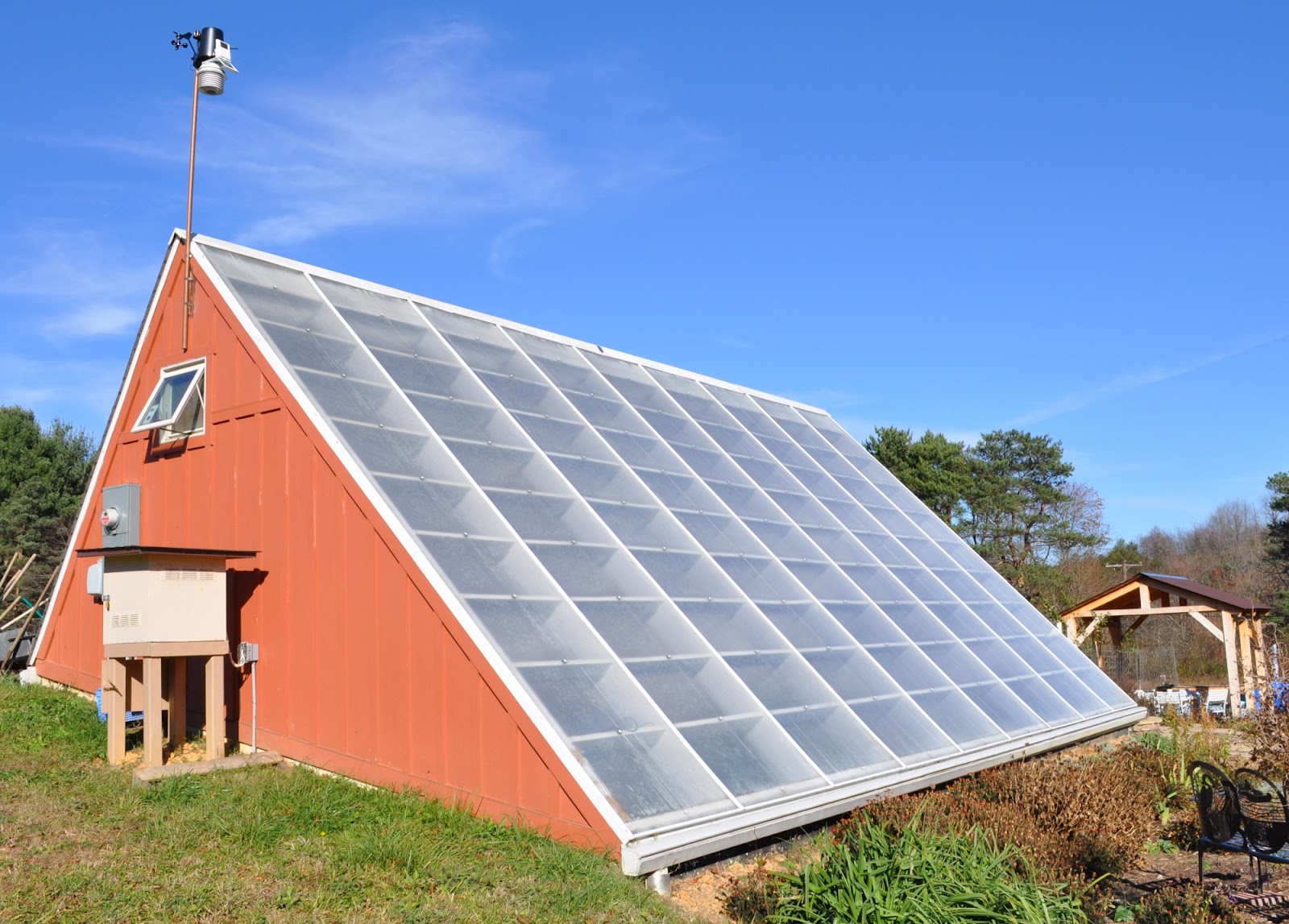
Solar Greenhouse Uses Underground Heat Sink
As food security becomes an issue everywhere, more and more people are opting for the ability to raise their own food year-round.
In the Appalachian Mountains, in Blacksburg, Virginia, the local YMCA
has built a solution for climates with cold winters.The YMCA Solar Greenhouse in Blacksburg, Virginia, USA, uses a novel way
to store energy collected from the sun: a subterranean heat sink of
soil, rocks and water beneath its interior planting beds. This system is
called the Subterranean Heating and Cooling System (SHCS), and it
collects solar energy and stores it for use when the sun is not shining.
This 18'x32' solar greenhouse is constructed with its long axis running
east and west, instead of north/south; it employs a heavily insulated
north roof as opposed to a transparent or translucent roof on the north side.
When outside conditions are very cold, heat is stored during the day in
the ground and walls of the greenhouse and released during the night to
keep the greenhouse air warm. Other solar greenhouses typically store
the sun’s energy in water barrels and/or rocks along the north wall
inside the greenhouse - taking up valuable floor space. Conventional
greenhouses are also constructed on a long north/south axis, with
glazing on both slopes of the roof; conventional greenhouses tend to
overheat when the sun is shining and get too cold during winter nights. This solar greenhouse was designed by retired physics professor, Dave Roper. At an estimated cost of $35,000USD in 2010, the greenhouse project could seem out
of reach to the average homeowner, but Roper says the design can be
adapted to smaller spaces and could be built using recycled materials, which could bring
costs down.



Monday, August 6, 2012
Ancient Village Endures 5,000 Years in Scotland

Skara Brae on Solaripedia
Skara Brae was inhabited before the Egyptian pyramids were built, and
flourished for centuries before construction began at Stonehenge. After 5,000 years, the houses at Skara Brae still tell a story of the inhabitants' 600 years of culture and history through intact ruins on the west coast of Mainland, Orkney, Scotland. The secret of their endurance lies partly in their semi-subterranean stone construction, as well as being covered by sand for eons. The ten homes were buried in ancient middens - which would have provided effective insulative value - and the buildings are connected to each other via mostly underground passageways, forming a tight-knit little village. In 3,000 BCE, the community would have been farther inland, before the sea eroded the shore to where it is today. There may be a lesson in such stone construction; even Thomas Jefferson counseled against structures made of wood, which he believed could never improve a country to any considerable degree. Wood, he wrote, whose duration is estimated at 50 years, becomes a tabula rasa every half century. "Whereas when buildings are of durable materials, every new
edifice is an actual and permanent acquisition to the state, adding to
its value as well as to its ornament.”
Subscribe to:
Posts (Atom)

