The CO2 Saver House in Lake Laka Poland weathers subzero winter winds and 90-degree summer heat. The home uses a solar water heater above the atrium for hot water that provides 30 to 40 percent in winter and 100 percent in summer. The orientation of the house is specifically designed to expose 80 percent of the structure to light and warmth through the sun’s daily arc. (The total surface area in a conventional building available for solar gain is typically about 65 percent.) The long side of the wedge on the CO2 Saver means there is more surface area to absorb solar energy, plus most of the roof slopes north to south, and all sides of the house have the potential to harvest power.
Friday, January 8, 2010
Poland Embraces CO2 Saver Home
The CO2 Saver House in Lake Laka Poland weathers subzero winter winds and 90-degree summer heat. The home uses a solar water heater above the atrium for hot water that provides 30 to 40 percent in winter and 100 percent in summer. The orientation of the house is specifically designed to expose 80 percent of the structure to light and warmth through the sun’s daily arc. (The total surface area in a conventional building available for solar gain is typically about 65 percent.) The long side of the wedge on the CO2 Saver means there is more surface area to absorb solar energy, plus most of the roof slopes north to south, and all sides of the house have the potential to harvest power.
Monday, January 4, 2010
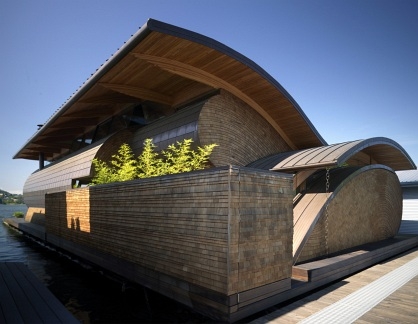
Floating House Captures Sun for Daylighting
Architect Robert Oshatz is well known for his unique approach to design and architecture. His creations are expressions of identity and form and this house boat comes as no exception. Oshatz wanted to design a house that would only function if it were situated on water, not something that could work equally well on land. The actual construction of the home had to occur offsite, on the connected Columbia River, then pulled by barge to its mooring. Also, moorings on either side were less than 10 feet away, so the house had to provide privacy despite the close proximity to neighbors.
Envirotorial Cartoons
Global Swarming produces copyrighted envirotorial cartoons that can be customized for a particular industry, business, client or topic. All cartoons are available to use for a nominal fee per one-time published use. Email info@solaripedia.com for permission.
Thursday, December 31, 2009
Massachusetts Beach House Is Zero Net Energy
The Truro Beach House is a zero energy home, which means that it produces as much energy as it consumes on an annual basis. This high performance home has a super-insulated building envelope, ground (geothermal) source heat pump, and 11.7KW of solar energy on the roof. The geothermal system, coupled with radiant heating and central air, supply the home’s heating and cooling needs throughout the year. A heat recovery ventilator provides fresh air throughout the year while exchanging heat between the incoming and outgoing air steams, minimizing the energy penalty of fresh air ventilation. Since the home is designed as a vacation residence with varying occupancy, it is is split into two volumes – a ‘Living Bar’ and a ‘Sleeping Bar’ - so that half the home can be decommission for the majority of the year to conserve energy.
Wednesday, December 30, 2009
Wind Farm Brings Employment to Texas
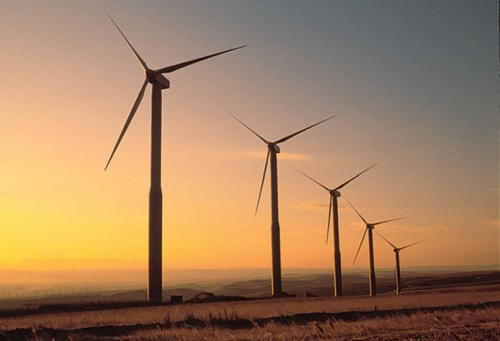
The Horse Hollow Wind Energy Center, spread across a vast area of West Texas, was the largest in the world when it was completed in 2006. Through three stages of development it reached a total installed capacity of 735 Megawatts (MW), with 421 individual wind turbines. On average, it can supply enough electricity for 180,000 Texan homes. The wind farm has helped boost employment in West Texas, which was in economic decline until the wind industry arrived. In Nolan County, where many of the Horse Hollow turbines are located, the oil wells began to dry up in the 1990s. By 2004, 20% of the population was living in poverty, according to the US Census Bureau.
Monday, December 28, 2009
Largest University Solar Farm Lights Up Florida
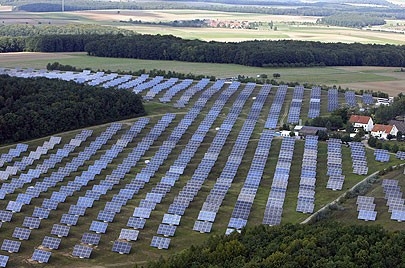
Florida Gulf Coast University’s long-awaited solar field has gone live, with the full 2-megawatt system now powering several main buildings on campus. With a 16-acre field of 10,080 panels, the electricity they generate will be enough to power about 600 homes. FGCU is home to the Center for Environmental and Sustainability Education.
Horse Hollow Wind Farm in Texas Is 735 MW
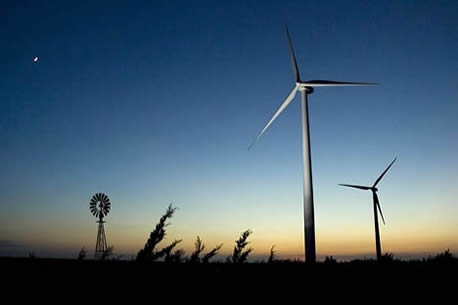
The Horse Hollow Wind Energy Center, spread across a vast area of West Texas, is the largest in the world. Through three stages of development it has reached a total installed capacity of 735 Megawatts (MW), with 421 individual wind turbines. On average, it can supply enough electricity for 180,000 Texan homes. The wind farm has helped boost employment in West Texas, which was in economic decline until the wind industry arrived. In Nolan County, where many of the Horse Hollow turbines are located, the oil wells began to dry up in the 1990s. By 2004, 20% of the population was living in poverty, according to the US Census Bureau.
Subscribe to:
Posts (Atom)